
Calhoun 72 Hour Release Review
No sheriff route is labeled as a rolling 72-hour release list. The official Calhoun County Jail page instead says every booking stays online for at least one week with a released date. That is a broader window than three days. A reader can review records dated within the last three calendar days, but the system does not perform that filter or promise chronological order.
The wider local display is useful when the exact release day is not known. It also demands care. “At least one week” states a minimum. It does not mean every visible name was released within seven days, and the sheriff gives no maximum retention period. Read the released date on each record. If a record supplies only a date, it cannot place the release to the minute within a rolling 72-hour boundary.
The sheriff's own jail instructions document the local release-date window:
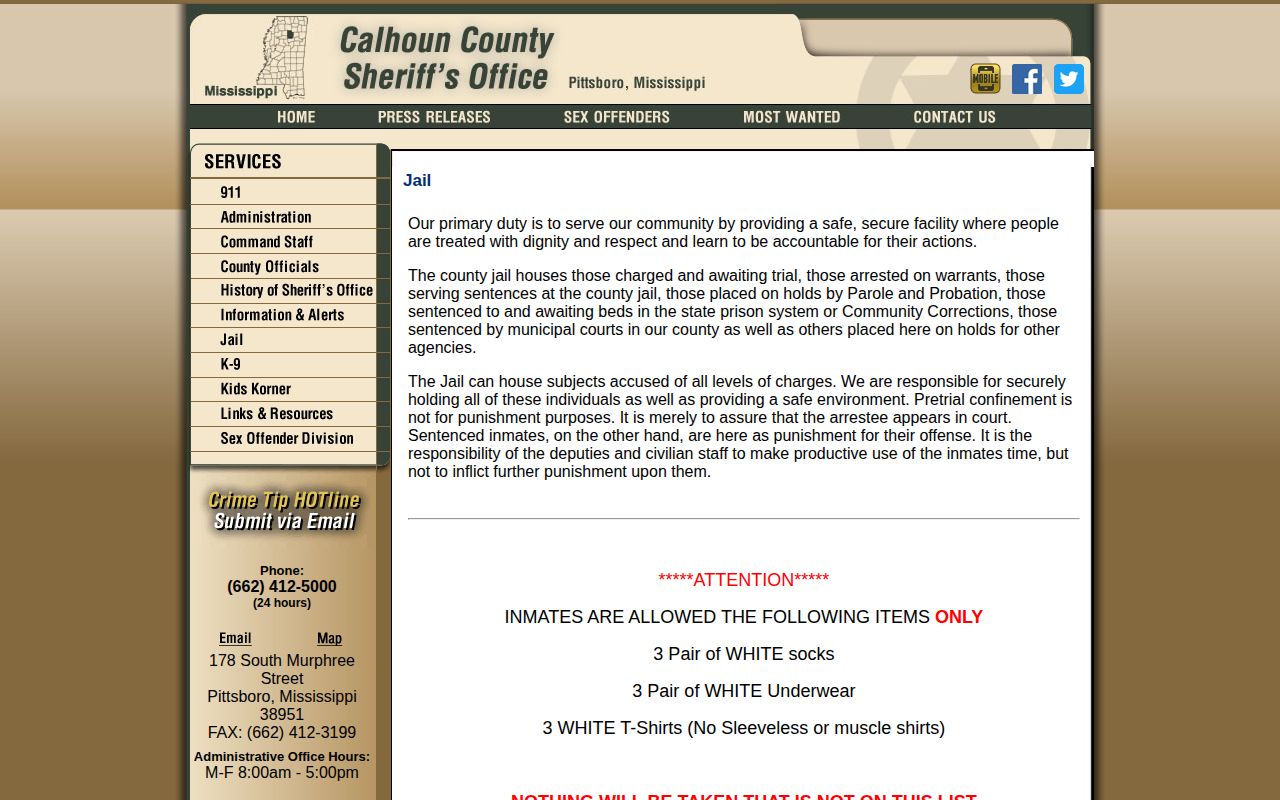
This image supports use of the page as a dated recent-record view, not as a dedicated three-day report.
Review Calhoun Three-Day Releases
Choose whether the inquiry means three named calendar dates or the prior 72 clock hours. The public released-date field supports a calendar comparison. It does not support an hour-by-hour cutoff. When exact timing matters, request the jail-docket discharge entry and ask whether a time of discharge is recorded.
- Write down the three Mississippi calendar dates that define the review.
- Open the official Calhoun jail display and find entries marked with a released date.
- Keep records whose released dates fall within the selected dates.
- Open a highlighted name in VINE and compare the agency, event type, and date.
- Check the receiving system when VINE or the jail indicates a transfer.
- Request the permanent docket entry for an older, missing, or unclear booking.
A day-wide search can include more than a community release. Calhoun County Jail holds county prisoners, municipal prisoners, supervision holds, state-bed waits, and people held for other agencies. A move to MDOC ends the Calhoun episode but continues custody. The state inmate search should be used only when the case has an MDOC link.
Note: Save the date range with the result so a later reader knows which three days were actually checked.
Calhoun 72 Hour Release Fields
Calhoun's published explanation confirms only a few public elements. It does not guarantee the release reason, exact time, destination, charge, booking number, bond amount, or court on each displayed record. Those details may exist in the underlying booking sheet, jail docket, or court file even when the public view does not show them.
| Public element | How to use it |
|---|---|
| Person's name | Match the booking carefully and use a highlighted name for the VINE handoff. |
| Released date | Compare it with the chosen three dates; do not infer an exact time. |
| VINE More Info | Read the reported custody event and feeding agency. |
| Gray VINE image | Open it when available to view the linked booking photograph. |
The released date is the key Calhoun field. It means the sheriff recorded an end to that jail episode. It does not by itself answer whether the person went home, entered state custody, returned to supervision, or moved to another agency. A destination or receiving record resolves that second question.
Calhoun Weekend Release Checks
A three-day review often crosses a weekend. That gives it a practical advantage over a same-date search when someone heard about a release after offices reopened. Yet Calhoun publishes no weekend processing schedule, holiday policy, release exit, property pickup hours, or stated delay between operational discharge and the online update. Those gaps cannot be filled with practices from another Mississippi jail.
Use dates, not assumptions about office hours. The sheriff's main telephone, 662-412-5000, is marked available 24 hours, while administrative office hours are Monday through Friday from 8:00 a.m. to 5:00 p.m. Phone availability does not mean a public feed covers 24 hours or that records staff can fill every request at once.
A court can also create a timing difference. A judge may sign a bond, dismissal, or release order before jail staff finish identity checks, holds, property return, and discharge steps. The order explains legal authority. The jail entry records the custody endpoint. Keep both rather than forcing them into one date.
Holiday timing has the same limit. Calhoun does not publish a rule that moves a release to the prior or next workday. Call the jail when a court date, planned pickup, or records-office closure makes timing unclear. The answer must come from the local record, not a custom used by another jail.
Calhoun Release Display Retention
The local roster rule has two parts. Current inmates are posted, and released bookings remain for a minimum period with a released date. No update cadence or maximum archive is stated. A record can therefore be online longer than the three-day target, while an older record can later disappear from public view. Manual date review is essential.
Long-term county records do not vanish with the web entry. Mississippi's county retention schedule makes the jail docket permanent and says it includes the date of discharge. An inmate case file is kept for 25 years after release. Other series, including property, funds, communications, and arrest reports, have their own periods. Retention does not guarantee that each part is open without redaction, but it creates a durable route for a focused request.
- Online visibility
- A short public display with no published maximum or update cycle.
- Jail docket
- The permanent county ledger used to establish the recorded discharge date.
- Case file
- A longer-retained file that may hold booking and release context, subject to access limits.
Note: A missing online name should be described only as “not located in this search,” never as proof of release.
Verify Calhoun Release Destinations
Start the fallback with the record owner. Send a focused request to the Calhoun County Sheriff's Office at 178 South Murphree Street, Pittsboro, MS 38951. Identify the person, approximate booking date, and any known case or booking number. Ask for the jail-docket entry, booking sheet, release date and time, and the recorded release type or destination. No fixed sheriff records fee schedule is published, so request electronic delivery and an actual-cost estimate.
Next, use VINE to read the custody event. Mississippi's service can report release, transfer or facility move, temporary movement, escape or abscond supervision, and return to custody. A transfer alert means custody continued elsewhere. For state transfer, the MDOC inmate search can show state location, sentence data, and a tentative release date. That tentative date predicts a possible future event and does not prove release occurred.
The originating court explains legal action. Justice Court is relevant to county misdemeanor and bond matters. Circuit Court handles felony prosecutions and appeals. City matters belong with the proper Municipal Court. A generic Calhoun County Court portal was not verified, so the request must follow the actual case.
| Question | Best Calhoun channel |
|---|---|
| When did local custody end? | Sheriff released-date field or permanent jail docket |
| Was the event release or transfer? | VINE event plus receiving agency |
| Did state custody begin? | MDOC inmate search by name or ID |
| Why was release authorized? | Originating court order and docket |
Calhoun 24 Versus 72 Releases
The narrower check is best when the date is known and the question is who left during that day. The three-day review is better when a weekend, late report, or uncertain date could place the event outside one calendar day. Neither view is an official sheriff filter. Both depend on the same broader released-date display.
Use the Calhoun County Jail Releases: 24 Hours page for the same-day method. For one named person whose custody type is unclear, the Calhoun County released-inmate lookup routes the inquiry among the sheriff, VINE, MDOC, court, BOP, or ICE. Choosing the system by custody class avoids a false conclusion from a database that never covered the case.