
Calhoun Parole and Probation Compared
Parole and probation both allow a person to live in the community under rules, but they start in different ways. The Mississippi State Parole Board decides whether to grant or revoke parole from an eligible state sentence. A court imposes probation as part of a criminal disposition. Post-release supervision and earned-release supervision, often called ERS, are separate legal forms of control. Under Mississippi Code §47-7-5, the MDOC Division of Community Corrections has the supervision role.
A Calhoun County Jail departure does not establish parole or probation. The jail houses pretrial defendants, county-sentence prisoners, people on supervision holds, municipal prisoners, and people waiting for an MDOC or Community Corrections bed. Some return home. Others transfer. The legal record and the supervising system must be checked apart from the local released date.
| Feature | Parole | Probation |
|---|---|---|
| How it begins | Conditional release from an eligible state sentence | A court orders community supervision |
| Decision authority | Mississippi State Parole Board | The sentencing court |
| Public name search | MDOC Parolee Search covers active parole | No general public probationer-name search was verified |
| Local contact | Calhoun Probation & Parole Office, MDOC Community Corrections | |
| End point | Formal discharge or expiration under the controlling sentence and order | |
- Parole
- Conditional community release from a state sentence before final discharge.
- Probation
- A court-ordered community disposition with conditions and oversight.
- Absconder
- A supervised person reported as having stopped complying with required contact or location rules.
- Discharge
- The formal end of the agency's sentence or supervision relationship.
Check Calhoun Post-Release Supervision
Start with the custody class. The MDOC Parolee Search is labeled for active state parole. It accepts first name, last name, MDOC ID, city, and county. A detail may show the MDOC ID, county, supervising officer, Flat Time Date, photograph, and identity traits. These fields help distinguish two people with similar names. They do not create a historical discharge archive or a general probation database.
The verification path changes if the parole search is blank. A no-result means only that the person was not located in that search. It may reflect spelling, a probation case, completed discharge, or a county episode that never entered MDOC. The local office and sentencing court are then the relevant channels. The broader Calhoun County released-inmate search path can establish whether the person left the jail, transferred, or entered state custody.
- Confirm the full name and obtain the MDOC ID when available. Separate a Calhoun jail booking number from a state MDOC number.
- Search the MDOC parole portal by the strongest identifier. Compare county, photograph, officer, and other displayed details before accepting a match.
- If parole is not located, call the Calhoun Probation & Parole Office and ask for the proper way to verify releasable supervision status. Do not assume probation is searchable online.
- Check the sentencing court docket for probation, post-release supervision, revocation, or discharge entries. A court order explains the legal basis.
- For a parole grant or decision question, contact the Mississippi State Parole Board. Confirm physical release separately because a grant can precede processing.
The official active-parole search page shows the state entry point used for this check.
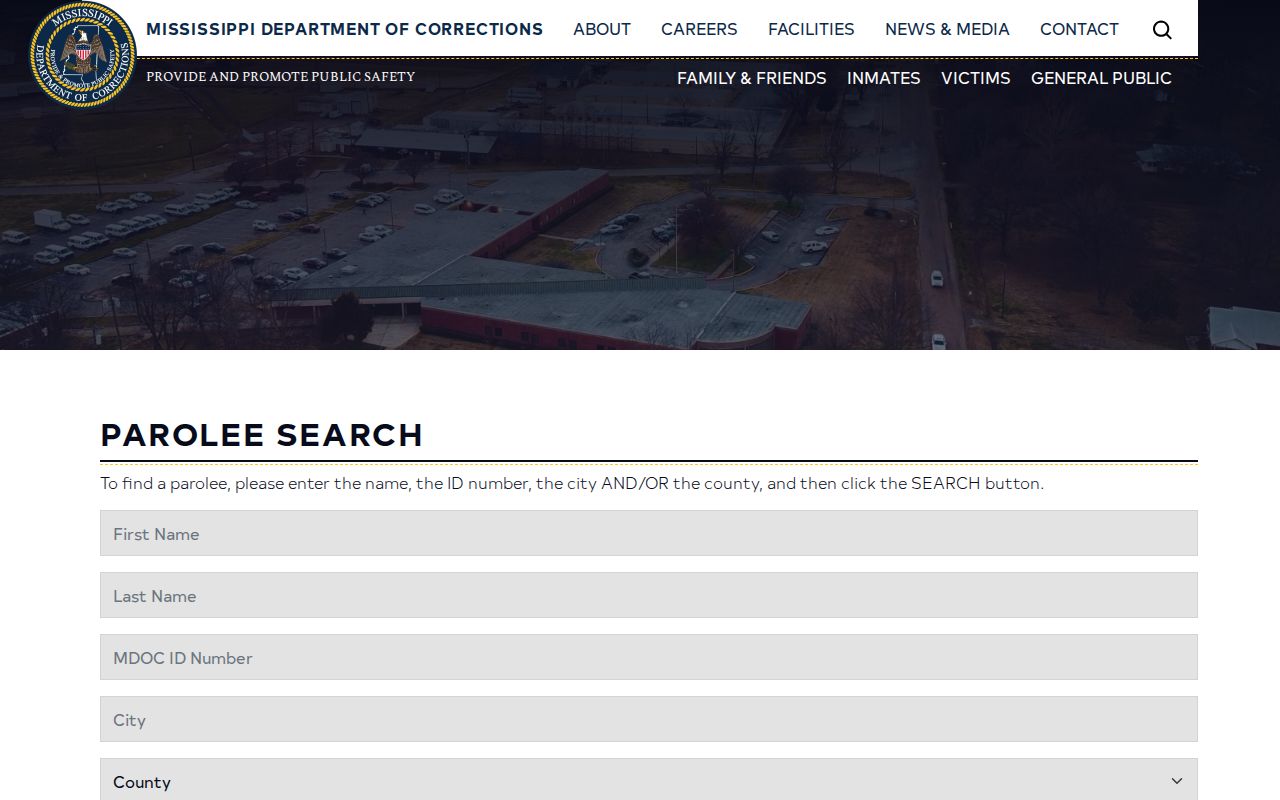
This portal is specific to active parole and should not be relabeled as a search for every person on Calhoun County probation.
Note: Match an MDOC result to more than a name because a wrong-person match can produce a false supervision conclusion.
Calhoun Probation and Parole Office
Calhoun County has a dedicated Community Corrections office in Pittsboro. It is a supervision office, not a jail or release-record archive. MDOC guidance directs a supervised person who needs the assigned agent to contact the probation and parole office in the county of assignment. For another caller, staff may limit what can be disclosed. A focused request should ask whether status can be confirmed, which office owns the case, and what official record can be obtained.
The official Calhoun office listing is the source for the local address and phone information.
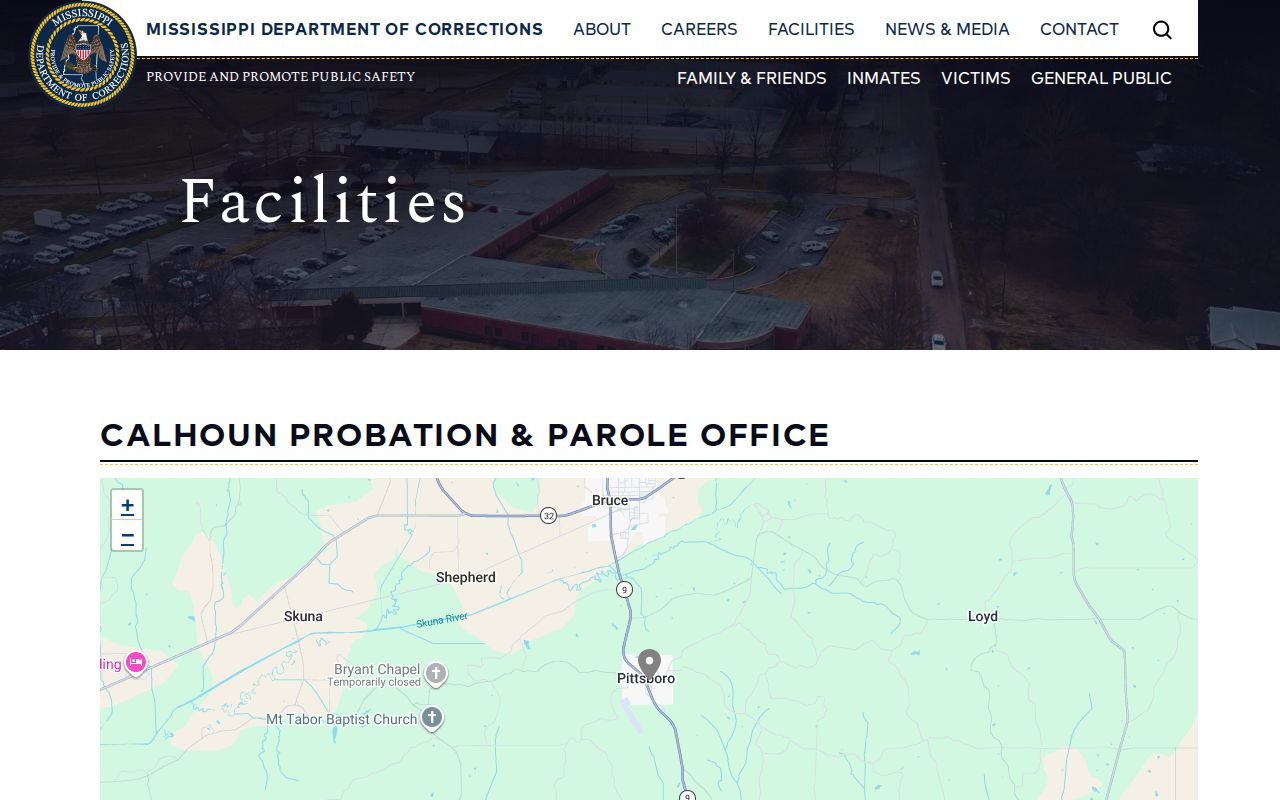
The local listing provides the direct route when a parole search cannot answer a probation or office-assignment question.
Calhoun Probation & Parole Office
111 East Main Street
Pittsboro, MS 38951
Mail: PO Box 176
Phone: 662-412-2314
Fax: 662-412-2322
MDOC identifies Tony P. Harris as Community Corrections Director. That statewide role does not replace the assigned field officer or the Calhoun office. When exact conditions matter, seek the order or supervision document rather than relying on a summary from a public search.
Calhoun Parole Decision Records
The Mississippi State Parole Board decides grants and revocations, while Community Corrections carries out supervision. Hearings are scheduled monthly, and the state generates an eligibility list each month. Administrative rules make hearings closed to the public. No verified public person-by-person hearing calendar or decisions database was found, so a name should not be promised in a browseable results list.
Supported Board outcomes include grant, refusal or denial, and revocation. A denial requires a written statement to the inmate with reasons and a set-off period. Under §47-7-18, eligible cases may follow different hearing paths based on the case plan, discipline, victim requests, supervision terms, and discharge plan. Eligibility remains distinct from release.
Mississippi State Parole Board
239 North Lamar Street, Suite 501
Jackson, MS 39202
Phone: 601-576-3520
Email: MSStateParoleBoard@mdoc.state.ms.us
A Board grant can be followed by release planning and state processing. MDOC materials describe a processing period that may take 30 to 45 days and require a discharge certificate. The case manager or state record supplies the exact date. The grant itself is not proof that the person has left a facility.
Note: Board eligibility, a grant decision, physical release, active parole, and final discharge are five different record events.
Calhoun Supervision Rules and Violations
Conditions come from the controlling court order, Board decision, or supervision record. At a high level, the record may require reporting to an officer, compliance with stated restrictions, and completion of a case plan. The exact terms are person-specific. A missed requirement can lead to violation or revocation proceedings, but an allegation alone does not prove that parole or probation has ended.
VINE can send status-change notices for escape, abscond supervision, and return from abscond status. It does not provide a browsable list of all Calhoun County absconders. A VINE alert should be matched to the person and checked with MDOC. If the person was booked at Calhoun County Jail on a supervision hold, the county booking can end while the revocation matter continues.
A warrant, violation flag, or abscond alert does not establish the original Calhoun County release date or the person's current custodian.
Calhoun Warrants and Abscond Alerts
The Calhoun County Sheriff's Office publishes a Most Wanted page. MS SAVIN separately supports registered escape and abscond-supervision events. These tools answer narrow questions. Most Wanted is a fugitive or warrant page, while SAVIN is a person-specific status notification. Neither is a complete list of released people, probationers, or parole decisions.
A match calls for more checks. Confirm the identity, obtain the court or MDOC case context, and ask the responsible office whether the status remains active. A person can have an old Calhoun release record and a later supervision event. Conversely, a blank Most Wanted page or an absent VINE alert does not establish compliant supervision.
The distinction also protects against a common error: treating a return-to-custody alert as proof that the person never left jail. The first release and later event can both be true. Preserve each event date and its source.
Calhoun Supervision Discharge Records
Supervision ends through the formal process that governs the sentence or court order. A jail released date proves that one local custody episode ended. It does not prove that state parole, probation, ERS, or post-release supervision ended at the same time. Active parole is supported by the parolee record; probation and other court-ordered terms are supported by the court and local office records.
For complete state discharge, the stronger record is an MDOC discharge or release certificate, not a vanished public profile. MDOC Records accepts written requests through its General Public records route. A focused request can seek the actual discharge date and type, MDOC ID, last facility, and releasable certificate. The sentencing court may also hold an order that terminates or modifies probation.
Keep physical release and legal discharge separate in any timeline. Parole and ERS let a person leave a facility under continuing control. Final discharge marks the end of that relationship. When the public search, court docket, and agency record conflict, record each source and ask the owner of the controlling record to resolve the difference.
Note: A public search is a useful lead, while the signed order or discharge certificate is the stronger closing record.